[Seeing Infrastructure] Part 4. Ground & Maritime FLIR: Distinguishing Targets When Visibility Breaks Down
The promise and limits of MWIR/LWIR dual-band sensing—and the full stack required to operate through degraded visibility and complex backgrounds

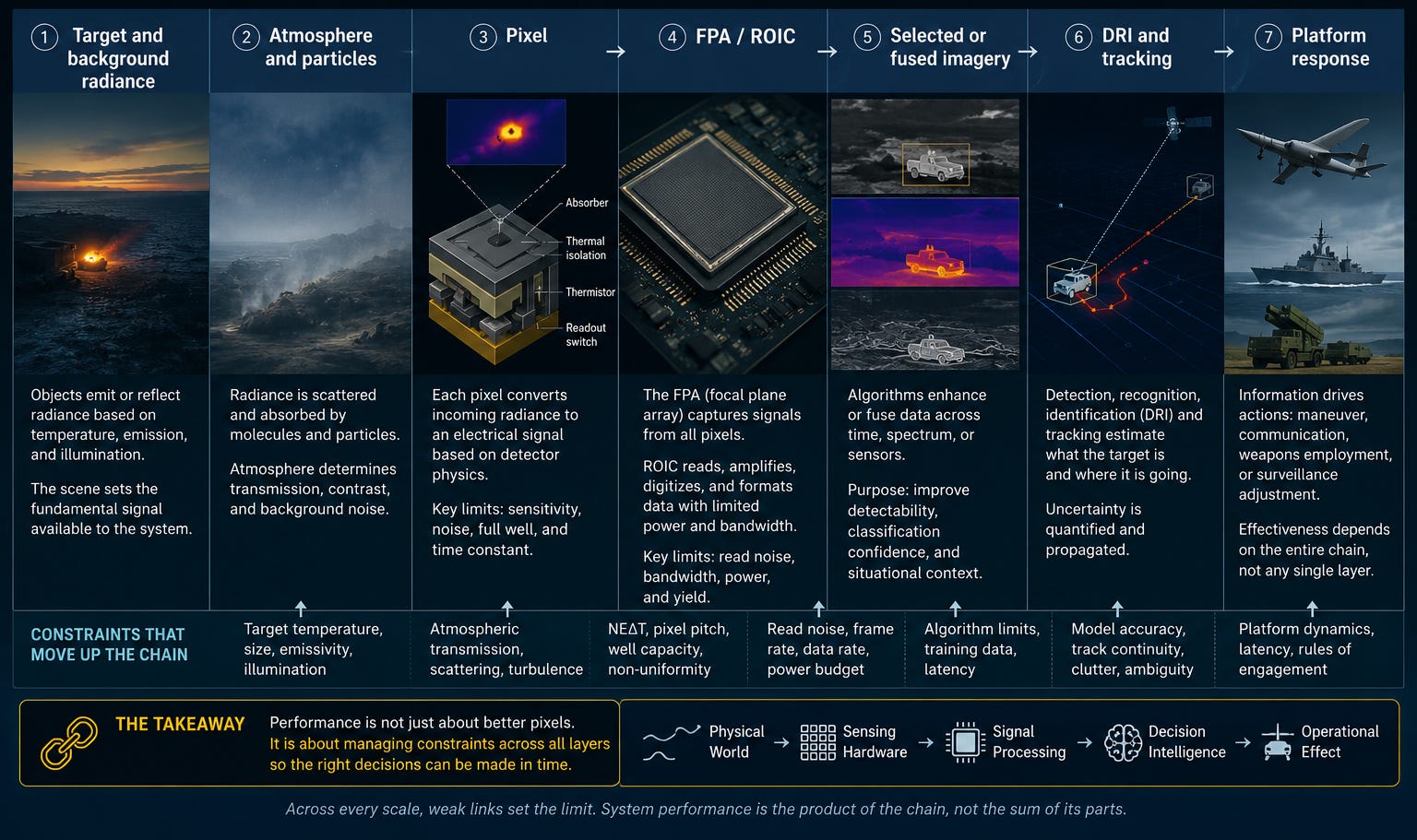
The mission value of ground and maritime FLIR is not determined by detection range alone.
Does the signal survive fog and dust? Can the system distinguish a vehicle from hot terrain? Can it separate a small target from sea haze and waves without generating excessive false alarms? Once detected, can the target be maintained as the same track over time?
Imagine a tank crew detecting a distant hot spot through dust. If the crew cannot tell whether it is an enemy vehicle, a sun-heated rock, or burning debris, long detection range has not yet become tactical advantage. A shipborne sensor may detect a small point near the horizon, but if that point alternately resembles a small vessel, a wave crest, or a cloud edge, the result is not a track. It is a false-alarm problem.
The central question in Part 4 is therefore not, “Which infrared band is better?”
Under a specific combination of target, background, path, weather, and platform constraints, which spectral information survives—and can that information be converted into sufficient probability of detection, low false-alarm rates, Detection–Recognition–Identification performance, and continuous tracks?
The value of MWIR/LWIR dual-band sensing is not that one band can see through every condition. Its value lies in providing options: selecting the more useful band for a particular environment, cross-checking one band against the other, or combining them at an appropriate stage of processing.
But dual-band sensing is not free. Detector structures become more complex. Optics and cooling burdens increase. The two channels must be spatially and temporally aligned, calibrated, and processed.
This is not an essay declaring that dual-band sensing is inherently superior.
It asks whether the additional information from a second band produces enough mission value to justify the additional complexity and cost.
1. Detection range matters—but it is not sufficient
FLIR stands for Forward-Looking Infrared. It uses continuous infrared imagery to support surveillance, navigation, target detection, and fire control at night and under degraded visibility.
Its performance is often summarized as a distance: how many kilometers away can the system see?
There is no reason to dismiss range. Detecting a target farther away increases the monitored area and creates more time to assess and respond to a threat.
But seeing that something exists is different from knowing what it is.
A common framework for describing this distinction is DRI:
Detection
The system determines that an object is present.

Recognition
The system classifies the object into a category such as vehicle, person, or vessel.

Identification
The system determines a specific type, model, or configuration at the required level of detail.
Determining whether something is a threat may come after identification. It can require additional information about identity, location, behavior, armament, context, and rules of engagement.
For the same reason, a quoted “maximum DRI range” is incomplete without test conditions. Results depend on target size, aspect angle, atmospheric state, path length, optical aperture, pixel structure, MTF, whether the observer is a human or an algorithm, the required success probability, and the criteria used for detection, recognition, and identification.
The actual FLIR chain is closer to this:
Target and background infrared radiance
→ atmosphere, fog, dust, smoke, or maritime path
→ optics and spectral filters
→ FPA / ROIC
→ cooling and calibration
→ band selection, cross-checking, or fusion
→ clutter suppression and target detection
→ DRI
→ temporal track
→ operator decision and fire-control integration
Detection range is an important output of this chain.
It is not the whole output.
The question is not only whether a target can be seen at long range. It is whether the signal observed at that range can be classified and maintained as the same target over time.
2. Degraded visibility reduces performance along two overlapping axes
Fog, dust, smoke, and thermal clutter are often grouped together as a single “bad-weather problem.”
That framing hides the mechanism.
Yet it is also inaccurate to treat them as two completely separate failure categories. In operational scenes, two forms of degradation frequently act at the same time.
The first axis is degradation along the physical propagation path
Particles in fog, dust, and smoke absorb and scatter infrared radiation. The result is not merely a weaker target signal.
Target radiance may be attenuated. Spatial contours can be blurred. Scattered light and path radiance can be added to the sensor input, reducing target-background contrast.
The problem may therefore include:
attenuation of target radiance
+ path radiance
+ scattering blur
+ loss of spatial contrast
A larger aperture and a more sensitive detector can use the remaining signal more effectively. Cooling can reduce sensor noise.
But aperture and cooling do not increase atmospheric transmittance itself. Once spatial information has been destroyed by strong multiple scattering, a larger aperture cannot simply reconstruct it.
The second axis is confusion created by the scene and by the imaging system
Thermal clutter is structured background energy that resembles a target or masks its signal.
Hot terrain, sun-heated buildings, exhaust plumes, fires, cloud edges, waves, and sea haze can produce intensities, shapes, or motions similar to those of a target. Sensor nonuniformity, stray light, internal reflections, and residual calibration errors can also generate target-like artifacts.
One maritime infrared target-detection study found that, in its experimental imagery, clutter from waves, clouds, and sea haze could appear brighter than the real targets and generate large numbers of false alarms in conventional detection algorithms. This was a specific study using particular data and algorithms, not a universal fleet-wide performance statistic. But it clearly illustrates why signal arrival and target discrimination are different problems.
The two degradation axes can be summarized as follows:
Physical path degradation
→ reduced target-background radiance difference
→ reduced spatial information

Scene and system confusion
→ background structures and artifacts resemble targets
→ increased false alarms
Both can operate simultaneously in fog, dust, and smoke.
The central evaluation axis in Part 4 is therefore not one standardized scalar metric.
It is whether target-background separability is preserved through the entire stack under mission conditions.
3. A thermal imager does not directly see a temperature number
Thermal imaging is often described as “seeing temperature differences.”
That is intuitive, but technically incomplete.
The sensor does not directly measure an object’s temperature. It measures radiance entering the sensor within a particular spectral band. That radiance is affected not only by temperature but also by emissivity, surface material, reflected ambient radiation, atmospheric transmission, path radiance, and the spectral response of the sensor.
A target and background can therefore have different physical temperatures yet produce little radiance contrast in the selected band. Conversely, objects at similar temperatures may produce visible contrast because of differences in emissivity or reflected radiation.
The DSIAC history of FLIR technology similarly notes that detectability can arise from differences in both temperature and emissivity, and that emitted spectra vary with material and wavelength.
The more precise question is therefore not:
Is the target hotter than the background?
It is:
Does the target produce enough band-integrated radiance contrast relative to the background?
This distinction leads directly to the rationale for using MWIR and LWIR together.
The same target-background pair can produce different radiance contrast in different infrared bands.
4. There is no universal winner between MWIR and LWIR
MWIR generally refers to the mid-wave infrared region around 3–5 μm. LWIR generally refers to the long-wave infrared region around 8–14 μm.
The two bands do not produce identical images of the same scene.
Target and background radiance can differ by band. Atmospheric absorption and particle scattering differ. Optical diffraction, aperture requirements, detector materials, cooling, pixel structure, and readout trade-offs also vary.
A DSIAC history of U.S. Army GEN3 FLIR describes MWIR as offering nearly twice the range of LWIR under favorable weather, while LWIR had advantages in battlefield smoke, dust, and cold climates. But this is a historical U.S. Army system-level judgment tied to particular generations of sensors, optics, targets, and operational requirements. It is not a universal law determined by wavelength alone.
The same source also attributes GEN3 cost pressure to low detector yield and complex optics, while identifying multispectral processing, fusion, and operator display as continuing system-level problems.
A 2026 Applied Optics tabletop DVE experiment provides a more direct demonstration that relative band performance can change with conditions. The study compared six spectral bands—from visible through LWIR—in a small environmental chamber under oil-smoke, fog, and dust conditions.
The DVE effective transmission coefficient, (T_{\mathrm{DVE}}), derived from the experiment and used as an input to the NVIPM model, ranked:
Oil-smoke condition:
LWIR > MWIR

Fog condition:
LWIR > MWIR

Dust condition:
MWIR > LWIR
The result has clear limitations.
First, the smoke condition was specifically oil smoke, not every military obscurant composition.
Second, (T_{\mathrm{DVE}}) was an effective coefficient derived from the experiment and used in a model. It was not a universal atmospheric-transmission constant for all operational environments.
Third, the raw MWIR and LWIR cameras did not use identical detector and optical configurations. Detector type, pixel pitch, focal length, and F-number differed. The model normalized some system variables, but the raw imagery was not a perfectly controlled A/B comparison in which wavelength was the only variable.
The study therefore does not establish a permanent rule that “LWIR wins in fog” or “MWIR wins in dust.”
It shows that the band preserving more useful information can change with particle composition, size, concentration, path length, target-background conditions, optics, and detector design.
5. The value of dual-band sensing is not limited to a fused image
MWIR/LWIR dual-band sensing is often illustrated as two images combined into one.
That is only one possible operating mode.
A system may instead:
select the more useful band for the current environment

display both bands in parallel

detect in one band and cross-check in the other

combine features extracted from the two bands

combine decisions rather than pixels

allow the operator to select a preferred composite
If target contrast is stronger in MWIR, the system can prioritize MWIR. If clutter or a stray-light artifact dominates one channel, the other can be used for confirmation. If the bands provide complementary target features, processing can combine them.
The value of dual-band sensing is therefore better defined this way:
Its value is not that one band can see through every condition. It is that the system can select, cross-check, or combine band-dependent information in ways that may outperform an optimized single-band system under particular mission conditions.
The word “may” matters.
Potential value is not the same as demonstrated incremental performance.
The proper comparison is not simply dual-band versus no dual-band. It is:
optimized MWIR-only system

optimized LWIR-only system

environment-dependent band selection

detection in one band plus cross-checking in the other

feature-level fusion

decision-level fusion

pixel-level fusion
These approaches should be compared under the same target, path, weather, and optical conditions using probability of detection, false-alarm rate, DRI performance, track continuity, and processing latency.
The number of bands is not a sufficient condition for better performance.
If registration is inaccurate, calibration is unstable, crosstalk is high, or processing delay increases, a dual-band system can perform worse than an optimized single-band design.
Dual-band sensing does not eliminate failure.
It exploits the possibility that the two bands may not fail in exactly the same way.
6. In the U.S. Army’s 3GEN FLIR program, the product is a B-kit—not merely two bands
MWIR and LWIR are central to the U.S. Army’s 3GEN FLIR architecture, but they are not the whole system.
In 2023, the U.S. Army awarded Raytheon Technologies a low-rate initial production contract for 3GEN FLIR B-kits. If all options were exercised, the contract could reach $117.5 million, with the publicly stated period of performance extending to June 2027.
The Army described the B-kit as including a high-definition MWIR/LWIR dual-band FPA, a Dewar Cooler Bench, optics, and electronics that convert thermal radiation into imagery. The common B-kit architecture was intended for integration into combat-vehicle sights, beginning with the Abrams tank.
The official description makes the structure clear:
dual-band FPA
+ dewar and cooler
+ optics
+ electronics
= a B-kit that can be integrated into an operational sight
An “MWIR + LWIR” label does not by itself create a deployable system.
Leonardo DRS states that the third-generation FPA it helped develop combines MWIR and LWIR in one high-definition sensor and, in the U.S. Army context, improves range, resolution, and situational awareness relative to widely fielded second-generation LWIR-only systems.
This is valid evidence of what Leonardo DRS says it has built and what performance direction it claims. It is not an independent field test quantifying the size of the performance improvement under matched conditions.
The Army SBIR solicitation moves one layer deeper, into the FPA itself. It identifies required variables including defective-pixel clusters, dark current, noise, quantum efficiency, operability, spectral crosstalk, MTF, and NUC stability.
The same solicitation cites fog and dust-cloud penetration, resilience against bright-source stray-light artifacts, and improved target detection through band fusion as program rationales. But this is evidence of the Army’s technical requirements and assumptions—not independent proof that the target performance has already been achieved in the field, or that SLS universally outperforms HgCdTe.
The DSIAC technical history adds the downstream system problems: low detector yield, complex optics, cost, multispectral processing, fusion, and operator display.
The full 3GEN FLIR stack is therefore closer to this:
MWIR/LWIR FPA
→ ROIC
→ dewar and cooler
→ dual-band optics
→ nonuniformity correction
→ band selection, cross-checking, or fusion
→ DRI and tracking
→ sight and fire-control integration
No single layer is sufficient to evaluate the whole system.
7. Ground platforms: after range come DRI and fire-support integration
Detection range remains a central requirement for ground surveillance sensors.
A longer-range sensor can monitor a wider area and create more response time. But the ground mission does not end with detecting a thermal point.
The system must classify and identify the object. It must estimate location. It must track moving targets. It must transmit the result into reconnaissance and fire-support networks.
In 2025, the U.S. Army awarded 12-month Phase 0 OTA agreements for the FALCONS program to Leonardo DRS, Elbit America, and QinetiQ. Each agreement had an expected value of approximately $2 million.
FALCONS is planned to integrate the Army’s 3GEN FLIR and eventually replace both the LRAS3 and the Fires Support Sensor System beginning in FY2032. A program official described the objective as more than doubling the range of the existing LRAS3, but this was a program goal—not independently verified fielded performance.
Phase 0 focused on technology-maturity assessment, preliminary system models, performance-specification review, and soldier feedback.
At Soldier Touch Point 0 in February 2026, thirteen soldiers evaluated early contractor designs, including handles, button placement, graphical interfaces, displays, and ergonomics. The Army also described plans to integrate AI/ML-enabled aided target detection and recognition to reduce operator cognitive burden.
The public evidence therefore shows a system in early design and prototyping—not a fully fielded capability with independently verified operational performance.
FALCONS does not demonstrate that software matters more than range.
Range is necessary. DRI is necessary. Geolocation and network integration are also necessary.
long detection range
→ sufficient target-background contrast
→ stable DRI
→ accurate target location
→ low false alarms
→ network transmission
→ connection to reconnaissance and fire support
Long range becomes mission value only when the information acquired at that range survives into identification, geolocation, tracking, and fire-support integration.
8. Maritime sensing must handle small targets and moving backgrounds at the same time
Maritime FLIR is not simply ground 3GEN FLIR installed on a ship.
Maritime sensors look through long horizontal atmospheric paths. Targets near the horizon can occupy very few pixels. Waves, clouds, haze, solar reflections, and water boundaries move continuously and can generate target-like responses. Ship pitch, roll, and vibration move the optical line of sight.
A maritime infrared target-detection study found that, in its test imagery, clutter from waves, clouds, and sea haze could overwhelm the apparent brightness of real targets, making false-alarm suppression a central problem.
This does not make resolution less important.
The opposite is true.
As maritime targets become smaller, angular resolution, IFOV, MTF, pixel sampling, and sensitivity become more important.
But high spatial resolution alone is not sufficient. The system must also suppress maritime clutter, compensate for platform motion, control false alarms, and maintain tracks over time.
radiance from a small maritime target
→ long horizontal atmospheric path
→ sea haze, clouds, and surface reflections
→ stabilized optics and FPA
→ ship-motion compensation
→ small-target detection
→ maritime clutter suppression
→ temporal track
→ combat-system or navigation-system integration
The evidence linking maritime sensing directly to MWIR/LWIR dual-band superiority remains limited.
According to a 2023 U.S. Navy release, MUST-HITS was an Office of Naval Research Future Naval Capability effort, with NSWC Crane providing technical support and integration. It aimed to use high-resolution infrared sensors and digital back-end processing for long-range, real-time observation of multiple objects, with a planned transition into future SPEIR upgrades.
This supports the conclusion that the Navy values high-resolution infrared sensing, digital back-end processing, simultaneous multi-object observation, and software-driven upgradeability.
It does not directly establish that MUST-HITS uses a specific MWIR/LWIR dual-band architecture or that dual-band fusion has produced better fleet-level false-alarm or tracking performance.
The safer conclusion is therefore:
Maritime EO/IR performance depends on the combination of resolution, sensitivity, stabilization, clutter suppression, multi-target processing, and track continuity. Dual-band sensing is a technology option to be tested—not yet a publicly demonstrated dominant solution for maritime clutter.
9. Counter-drone is a small-target case, not the center of the essay
Counter-drone is a useful application of the Part 4 mechanism.
Small UAVs occupy few pixels. Their thermal signatures may be weak. Their features can disappear against terrain, buildings, or clouds. When several appear together, processing throughput and track management become additional problems.
A 2026 study of infrared small-UAV detection identifies low feature resolution, background clutter, and dense spatial distributions of multiple small UAVs as key difficulties. It also notes that the computational burden and inference latency of complex detection models can become problematic on resource-constrained platforms.
The study illustrates a small-target detection problem. It does not prove the detection range or engagement effectiveness of a particular military counter-UAS system.
The structure is:
small and weak target
→ resolution, IFOV, and sensitivity required

complex background
→ clutter suppression and false-alarm control required

fast target
→ frame rate and low latency required

multiple targets
→ processing throughput and track management required

engagement decision
→ possible fusion with radar, RF, acoustic, or external data
This is why counter-drone does not belong in the title.
The subject of Part 4 is not the drone market.
It is the full stack required to separate and track small targets through degraded paths and complex backgrounds.
10. Band selection also depends on platform size and mission
Selecting an infrared band and detector architecture is not purely an image-performance decision.
Cooled MWIR, cooled LWIR, and uncooled LWIR create different trade-offs in sensitivity, exposure time, size, weight, power, and cost.
A 2026 comparison of UAV-borne targeting sensors found that uncooled LWIR microbolometers were lighter and cheaper but disadvantaged in sensitivity and exposure time, while cooled LWIR provided higher sensitivity but could exceed the SWaP-C limits of small commercial UAVs.
Under the configuration and assumptions of that specific study, cooled MWIR provided a better balance among sensitivity, exposure, and SWaP-C. That result should not be generalized to ships, combat vehicles, or fixed surveillance systems.
The optimal stack can differ even for the same target and environment:
Large combat vehicle
→ can carry larger aperture and cooler
→ higher performance, but higher cost and maintenance burden

Ship
→ stabilization, salt exposure, and long horizontal paths matter
→ more power available, but greater integration complexity

Man-portable sensor
→ weight, power, and cooldown time are constrained
→ performance traded against endurance

Small UAV
→ severe SWaP-C constraints
→ detector, optics, and processing simultaneously limited
The question “Is MWIR or LWIR better?” leaves out the platform.
The more precise question is:
For a platform with a particular target, path, and mission, which sensor stack produces the required outcome at the lowest lifecycle cost?
11. Four criteria for judging Part 4
1. The physical target-background separation budget
How different are the target and background radiances within the sensor band? How much of that difference survives the atmospheric path? How much spatial contrast remains?
Relevant variables include:
band-integrated target-background radiance difference
atmospheric attenuation and path radiance
particle composition, size, and concentration
path length
aperture and optical throughput
MTF, IFOV, and pixel sampling
detector sensitivity and noise
2. DRI, false-alarm, and tracking outcomes
Can the system progress from detection to recognition and identification? Can it maintain detection probability under a specified false-alarm condition? Does the track survive movement and partial obscuration?
probability of detection
false-alarm rate
conditional DRI range
track-break rate
track-update rate
classification and identification confidence
Every number requires test conditions.
Is the false-alarm rate measured per frame, per hour, per field of view, or per unit area? What target, aspect angle, atmospheric condition, and success probability define the DRI range?
3. Incremental value of dual-band sensing
The relevant question is not whether the system contains two bands. It is whether the second band improves actual results relative to an optimized single-band system.
image-registration error
NUC stability
spectral crosstalk
processing latency
band-selection logic
cross-checking method
change in detection and false alarms after fusion
change in DRI and track performance
The decision criterion is:
Does dual-band sensing actually produce better probability of detection, false-alarm performance, DRI, or track continuity than an optimized MWIR-only or LWIR-only system?
4. Platform integration, availability, and lifecycle support
Can the sensor operate reliably on an actual vehicle, ship, or unmanned platform?
SWaP-C
cooler life and cooldown time
temperature and humidity
vibration and shock
salt fog and salt ingress
EMI/EMC
window contamination and cleaning
MTBF and MTTR
field replaceability
software upgradeability
mission availability
These are technical and operational criteria.
The industrial question is separate:
Which layer—detector material, dual-band FPA, ROIC, cooler, image processing, target-detection software, or platform integration—controls the real performance bottleneck, and does that control translate into repeat production, replacement cycles, and sustainment revenue?
12. Each source supports a different class of claim
Leonardo DRS
Leonardo DRS strongly supports the claim that the company describes 3GEN FLIR as a high-definition MWIR/LWIR dual-band sensor and claims improved range, resolution, and situational awareness relative to second-generation LWIR-only systems in the U.S. Army context.
It does not independently establish the size of field-performance improvement, universal superiority in fog, dust, and smoke, or program profitability.
U.S. Army 3GEN FLIR B-kit
The Army’s official material establishes that 3GEN FLIR is not merely an FPA. It is a B-kit containing a dual-band FPA, dewar and cooler, optics, and electronics, and it entered low-rate initial production.
Its use of language such as “overmatch” should not be treated as an independent matched-condition performance test.
Army SBIR
Army SBIR shows what FPA-level variables the Army requires and identifies fog, dust, bright-source stray light, and target detection as development concerns.
It does not independently prove that the target dual-band performance has already been achieved in field conditions, or that SLS has universal advantages in yield, cost, or DRI.
The fact that this source does not independently prove a claim is not the same as proving that the claim is false.
The 2026 DVE experiment
The paper demonstrates that spectral degradation differed across controlled oil-smoke, fog, and dust conditions, and that the relative ordering of MWIR and LWIR changed across those experimental-model conditions.
It does not establish a universal ranking for all battlefield obscurants or the performance of matched military sensors in the field.
FALCONS and MUST-HITS
FALCONS shows that the Army is pursuing longer-range DRI, AI-enabled target assistance, and networked fire-support integration in a future ground sensor. The public evidence shows a program in design, prototyping, and soldier-feedback stages.
MUST-HITS, based on the 2023 public release, shows that the Navy emphasized high-resolution IR sensing, digital back-end processing, multi-object observation, and software-driven upgradeability for maritime EO/IR.
It does not directly prove a MWIR/LWIR dual-band configuration or fleet-level operational performance.
13. What matters—and what is not sufficient on its own
Detection range matters.
But maximum detection range alone is not enough to judge FLIR mission value.
Resolution and IFOV matter.
But high spatial resolution alone does not automatically separate a target from its background.
Band selection matters.
But neither MWIR nor LWIR is universally superior across every target, path, weather condition, and platform.
A dual-band FPA matters.
But possessing two bands does not guarantee better results than an optimized single-band design.
Cooled detectors can provide high sensitivity.
But cooler power, lifetime, cooldown time, and maintenance requirements must fit platform availability.
Image processing and AI matter.
But software cannot reconstruct all spatial information after the physical signal has already been destroyed.
Counter-drone is an important application.
But the center of Part 4 is not a market category. It is the stack required to separate and track small targets through degraded paths and complex backgrounds.
14. Conditions under which the mission and economic advantage of dual-band sensing may weaken
The following conditions do not refute the broader full-stack thesis.
They test whether MWIR/LWIR dual-band sensing creates enough incremental mission value over an optimized single-band system to justify its additional complexity and lifecycle cost.
First, an optimized single-band system may satisfy the required detection probability, false-alarm rate, DRI, and tracking performance at a lower lifecycle cost.
Second, under favorable weather and simple backgrounds, aperture, IFOV, or maximum range may dominate performance, leaving little value for the second band.
Third, the mission may require only basic warning rather than detailed recognition or identification, reducing the value of additional spectral information.
Fourth, registration errors, NUC instability, crosstalk, and processing latency may offset the improvement expected from a second band.
Fifth, detector yield, complex optics, coolers, and electronics may raise cost and reduce deployment volume or operational availability.
Sixth, the dominant bottleneck in the engagement chain may be radar detection, target geolocation, networking, fire control, or weapon range rather than EO/IR.
Seventh, dual-band sensing may improve mission performance but still fail to justify higher production, maintenance, and sustainment costs.
A separate industrial question remains:
Even when dual-band sensing has strong mission value, there is no guarantee that the economic value will accrue to the detector or FPA supplier.
The value may concentrate instead in cooling, image processing, software, platform integration, or sustainment.
Closing
Long-range vision matters in ground and maritime FLIR.
But seeing farther is only the beginning.
Target-background radiance contrast must survive.
Spatial information must remain after fog, dust, and smoke.
The system must distinguish vehicles from hot terrain.
It must separate small maritime targets from waves and sea haze.
It must select the more useful infrared band when conditions change.
If the bands are cross-checked or combined, the result must improve actual mission performance.
And the output must become DRI, a temporal track, an operator decision, and fire-control information.
band-dependent target and background radiance
→ absorption, scattering, and path radiance
→ MWIR/LWIR optics
→ FPA / ROIC
→ cooling and nonuniformity correction
→ band selection, cross-checking, or fusion
→ clutter suppression and target detection
→ DRI and tracking
→ decision and response
Detection range matters.
Band selection matters.
Resolution and sensitivity matter.
But none of them can explain performance under degraded visibility on its own.
The strategic value of Ground & Maritime FLIR does not come from one band seeing through every environment. It comes from preserving band-dependent radiance contrast and converting it—through selection, cross-checking, or fusion—into the required probability of detection, low false-alarm rate, DRI, and track performance.
Part 4 leaves three judgments.
Demand for infrared sensing under degraded visibility and complex backgrounds is strong.
Whether MWIR/LWIR dual-band sensing is the optimal solution depends on the mission, environment, and platform.
Where the economic value concentrates—detector, FPA, processing, integration, or sustainment—remains an open question.
Part 5 moves that question onto an industrial map.
Seeing Stack: Public Map v0.1.
Who manufactures the detector material?
Who integrates the FPA and ROIC?
Who controls cooling, calibration, and processing?
Who owns platform qualification and long-term sustainment?
And which layer converts mission indispensability into contracts and economic returns?
Appendix — Technical Notes
1. Key terms
FLIR — Forward-Looking Infrared
A system using continuous infrared imagery to support surveillance, navigation, target detection, and fire control at night or under degraded visibility.
MWIR — Mid-Wave Infrared
Generally the 3–5 μm band. It may offer relative advantages for range and high-temperature targets under particular target, weather, and optical conditions.
LWIR — Long-Wave Infrared
Generally the 8–14 μm band. It may offer relative advantages in certain cold-background, smoke, fog, or dust conditions, but not as a universal rule.
DVE — Degraded Visual Environment
Conditions such as fog, dust, and smoke that reduce image transmission and target contrast.
DRI — Detection, Recognition, and Identification
The sequence of detecting an object, classifying its category, and identifying a specific type, model, or configuration at the required level of detail.
IFOV — Instantaneous Field of View
The angular area represented by one pixel. It is related to how many pixels a target occupies.
MTF — Modulation Transfer Function
A measure of how well an optical-imaging system preserves spatial detail and contrast.
NUC — Nonuniformity Correction
The process of correcting pixel-response variation and fixed-pattern artifacts in an FPA.
SWaP-C — Size, Weight, Power, and Cost
Physical and economic constraints affecting platform integration.
MTBF / MTTR
Mean Time Between Failures and Mean Time to Repair. These help describe operational availability and supportability.
2. Evaluation layers for target-background separability
Scene and path level
band-integrated target-background radiance difference
atmospheric transmission and path radiance
particle scattering
spatial blur
Sensor-output level
CNR — Contrast-to-Noise Ratio
SCR — Signal-to-Clutter Ratio
SCNR — Signal-to-Clutter-plus-Noise Ratio
MTF
NETD
pixel operability
NUC residual
Detection-task level
Pd — probability of detection
Pfa — probability or rate of false alarm
conditional DRI probability and range
Pd and Pfa should be reported together. High detection probability accompanied by excessive false alarms does not necessarily represent good mission performance.
False-alarm comparisons should specify whether the rate is measured per frame, per hour, per field of view, or per unit area.
Mission level
track-break rate
track-update rate
position error
processing and display latency
sensor availability
MTBF / MTTR
3. How to read the 2026 DVE experiment
The study’s core result is not that one band is always superior.
The reported ordering was:
Tabletop oil-smoke condition:
T_DVE — LWIR > MWIR

Fog condition:
T_DVE — LWIR > MWIR

Dust condition:
T_DVE — MWIR > LWIR
Important caveats:
- The smoke condition was oil smoke, not all battlefield obscurants.
- T_DVE was derived from the experiment and used as an NVIPM input.
- The raw MWIR and LWIR cameras did not use identical detectors and optics.
- The test did not reproduce every battlefield particle composition, distance, temperature, or wind condition.
- The result demonstrates conditionality, not a universal spectral ranking.
4. Minimum comparison structure for evaluating dual-band value
MWIR only

LWIR only

environment-dependent band selection

detection in one band plus cross-checking in the other

feature-level fusion

decision-level fusion

pixel-level fusion
Each should be compared under matched conditions using:
Pd / Pfa
DRI probability and range
track continuity
processing latency
SWaP-C
availability
lifecycle cost
5. Variables to verify next
- MWIR/LWIR performance by military obscurant composition
- band comparison using identical or normalized optics
- band-integrated target-background radiance contrast
- single-band versus dual-band Pd/Pfa
- conditional DRI range
- FPA yield and defective-pixel clusters
- spectral crosstalk
- long-term NUC stability
- spatial-registration and temporal-alignment errors
- change in false alarms before and after fusion
- track-break rate and false-track count
- cooler life and cooldown time
- salt-fog, vibration, and shock qualification
- MTBF, MTTR, and mission availability
- production quantity and contract options
- software and data rights
- sustainment and replacement-contract structure
Reference
https://opg.optica.org/ao/abstract.cfm?uri=ao-54-15-4689 “Texture orientation-based algorithm for detecting infrared maritime targets”
https://opg.optica.org/ao/abstract.cfm?uri=ao-65-19-H112 “Tabletop degraded visual environment chambers for passive imaging”
https://cpeisw.army.mil/2023/07/07/peo-iews-announces-3gen-flir-b-kit-low-rate-initial-production-contract-award/ “PEO IEW&S Announces 3GEN FLIR B-Kit Low-Rate Initial Production Contract Award - Capability Program Executive - Intelligence and Spectrum Warfare - CPE ISW”
https://usa.leonardo.com/en/press-release-detail/-/detail/leonardo-drs-award-critical-infrared-technology “Leonardo DRS recognised with prestigious award for role in development of Critical Infrared Technology”
https://armysbir.army.mil/topics/flir-dual-band-focal-plane-array/ “Forward-Looking Infrared (FLIR) and Dual-Band Focal Plane Array in High-Definition Forma – Army SBIR|STTR Program”
https://cpeisw.army.mil/2025/08/01/us-army-awards-ota-for-falcons/ “US Army Awards OTA for FALCONS - Capability Program Executive - Intelligence and Spectrum Warfare - CPE ISW”
https://cpeisw.army.mil/2026/02/25/soldiers-engage-with-advanced-battlefield-sensor-prototypes/ “Soldiers Engage with Advanced Battlefield Sensor Prototypes - Capability Program Executive - Intelligence and Spectrum Warfare - CPE ISW”
https://www.navsea.navy.mil/Media/News/Article-View/Article/3410274/nswc-crane-leads-office-of-naval-research-effort-to-enhance-electro-optics-infr/ “NSWC Crane leads Office of Naval Research effort to enhance electro-optics, infrared technology at sea > Naval Sea Systems Command > Article View”
https://opg.optica.org/ao/abstract.cfm?uri=ao-65-8-2613 “UDRT-DETR: a small UAV detection method based on infrared imaging and RT-DETR”
https://opg.optica.org/ao/abstract.cfm?uri=ao-65-4-1163 “Performance comparison of LWIR and MWIR systems for UAV-mounted targeting”